The case for nature: Tangaroa Stream shows a smarter way to build resilience
The first stage of the Tangaroa Stream flood resilience scheme in Waitara has returned the awa to Manukorihi Hapū at Owae Marae, while saving $400,000 in capital costs and providing improved flood resilience for the community.
With New Zealand's infrastructure at a critical intersection, will our growth continue to favour hard/physical systems, or will we start harnessing natural infrastructure solutions instead of forcing nature to bend to our needs?
The Aotearoa Circle's Natural Infrastructure Plan, released in March 2026, makes the case that nature-based solutions are not a compromise on conventional infrastructure; in many cases, they are simply the better option.
Central to the Plan are six case studies that go beyond theory: real natural infrastructure projects in communities across Aotearoa, with measurable financial and economic results. The Tangaroa Stream flood resilience scheme at Owae Marae in Waitara, Taranaki, is one of them.
A town surrounded by water
Waitara sits at the junction of the Waitara River and the Tasman Sea. Water edges the town's parameters and, for years, has threatened it, leading to the 2019 establishment of the New Plymouth District Council (NPDC) $15.8m Waitara Stormwater Project to address the ongoing flooding issues.

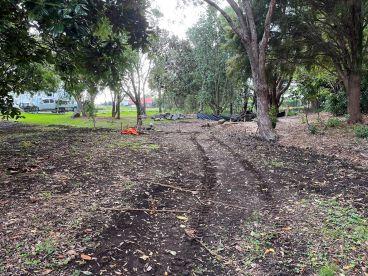
The programme's central focus was the daylighting of the Tangaroa Stream, to improve stormwater drainage and increase flood resilience for the wider community. Upstream development in the early 2000s had choked the stream with silt and weeds, restricting its flow. Compounding this, a significant section of the stream had been cut off from the whenua and community entirely, diverted underground through pipes beneath Owae Marae, restricting the stream’s movement and preventing it from doing what it was built by nature to do.
By 2022, planning work had begun on the scheme to daylight this section of the stream. The early engineering concepts followed the conventional playbook: removal of the pipe to form a geometric channel, steep battered banks, and an engineered cascade requiring extensive earthworks, and significant tree removal. It would have worked, being designed to manage the flood flows within the channel. But it would also have cost more, disturbed more, and delivered less.
More than an engineering problem
The stream had not always been a problem to be managed. For Manukorihi, the mana whenua of the area, the Tangaroa was the lifeblood of the community, and an essential waterway that had supported mahinga kai for generations. Their relationship with the awa and the whenua, as kaitiaki (stewards) and as part of their whakapapa brought them to the co-design table with a clear vision: to revive the awa and return it to the living waterway it had once been, restoring its mauri.
A better solution at a lower cost
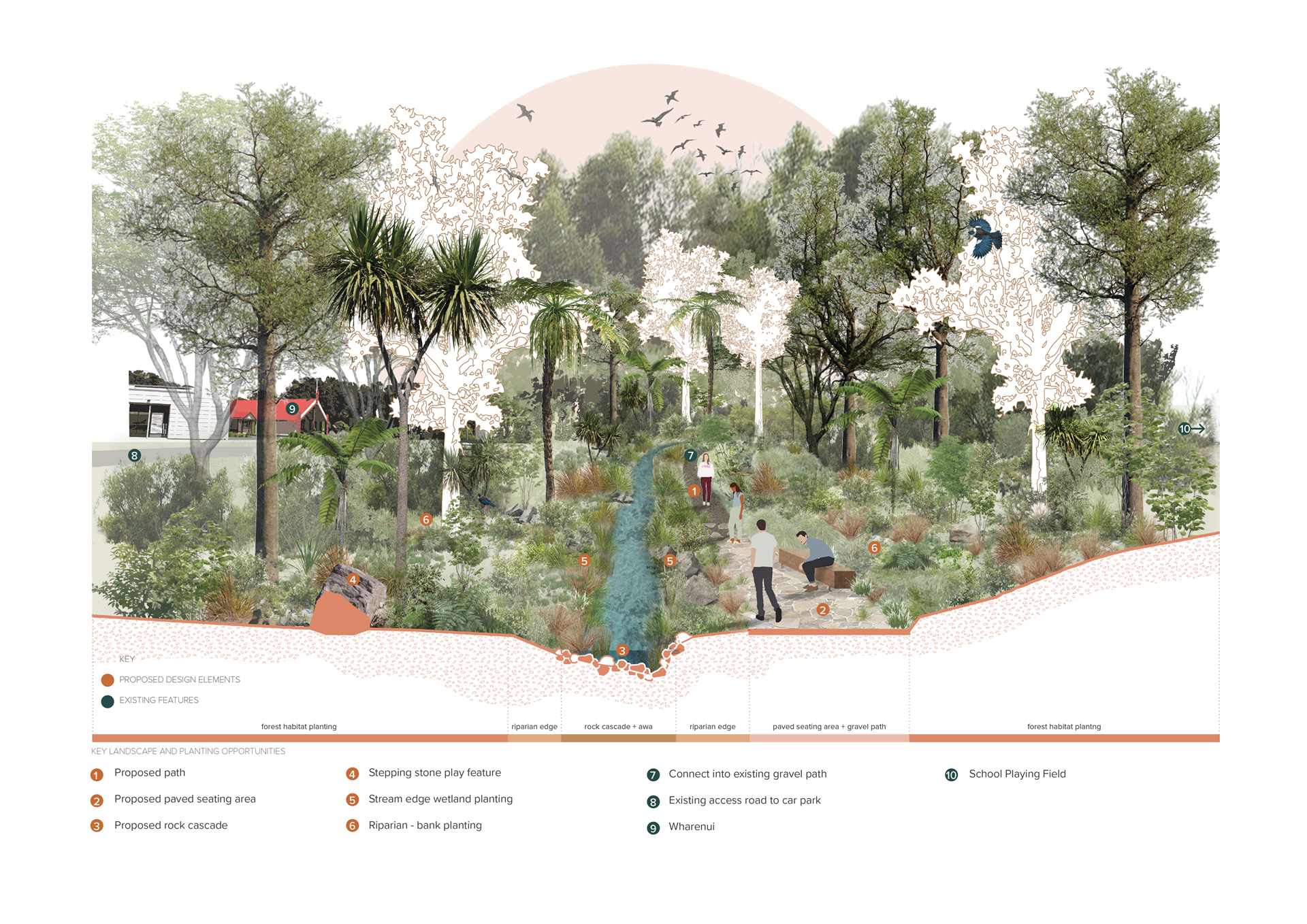
And New Plymouth District Council listened. Beca and Morphum Environmental worked within a Hapū-led co-design framework to develop a naturalised stream system: daylighting the ~ 170m section, restoring 260m of stream banks along its length, and completing the scheme with 0.3ha wetland restoration with paths, boardwalks and riparian planting. The $5.8 million budget for the wider scheme was funded by NPDC, with the former Ministry for the Environment's Freshwater Improvement Fund contributing $1.8 million.
The decision to follow Manukorihi Hapū's vision rather than default to the engineered option didn't just produce a better outcome for the environment. It produced a cheaper one. The naturalised design project saved $400,000 in capital expenditure, 7% of the total budget, through less earthworks, less soil disturbance, and less impact to taonga. The consenting process was smooth and efficient, avoiding the delays and compliance costs a more intrusive approach would have generated.
What it delivers
Completed in June 2025, the scheme has weathered its first wet season, providing improved flood resilience for approximately 60 properties, two schools, Owae Marae, the Waitara Community Pool, and the surrounding road network. These are assets whose combined value significantly exceeds the cost of the scheme protecting them.
“This project shows that infrastructure can work with nature rather than against it. By building strong relationships with Manukorihi Hapū and bringing together a diverse team of technical specialists, we have delivered a flood resilience solution that has restored the Tangaroa Stream as a living waterway while creating lasting environmental, cultural and community benefits. The result is infrastructure that performs today while strengthening connections to the awa for generations to come.” says Kelly Armfield Infrastructure Project Manager, New Plymouth District Council.
Emma Content, Associate Landscape Architect and Nature-based Solutions lead at Beca, adds, “It’s been an incredibly rewarding co-design partnership working with Hapū and councils that recognise the value of natural infrastructure based on mātauranga, and being able to demonstrate, what we inherently know, that they can help achieve lower capital costs, but also significantly enhance the natural and social assets of a community”.


Aligned with New Zealand's infrastructure strategy
The Aotearoa Circle Natural Infrastructure Plan was developed in alignment with Te Waihanga's infrastructure strategy for New Zealand. The Tangaroa Stream flood resilience scheme at Owae Marae contributed across all five of the Natural Infrastructure Plan objectives, and most strongly demonstrated two.
- Building inclusive and resilient urban infrastructure: restoring natural capacity that development had removed, rather than engineering around the problem.
- Strengthening resilience to shocks and stresses: a naturalised stream, co-designed with tangata whenua and built to last more than 100 years
Nature education and kaitiakitanga in action
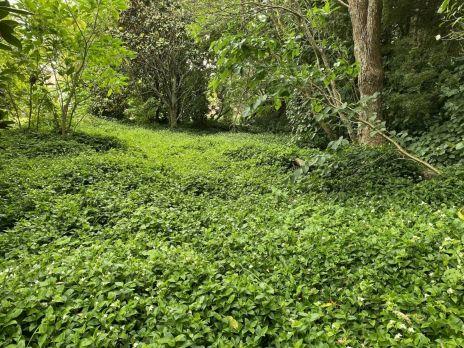
Since March 2024, weed management across the 1.5ha site has been carried out by Manukorihi Hapū, taonga species such as watercress is re-establishing along the stream, and kokopu have been spotted, all evidence that the ecological investment extends well beyond the scheme's formal completion.
The co-design team have also woven nature education into the site, utilising the 240m of pathways and 40m of boardwalks that weave through the site connecting to Marae buildings, adjacent schools and kōhanga reo, creating spaces for all to sit near the awa and hear the water moving through it. The design didn't just solve a flooding problem. It restored a waterway with natural flood resilience and strengthened a community.


Proving what is possible
The conditions that made this project possible exist across Aotearoa. With climate change bringing both heavier rainfall and longer periods of drought, we need to rethink how we invest in infrastructure. This flood resilience case study demonstrates that by recognising nature as infrastructure and designing in genuine partnership, we can build more resilient communities while delivering better outcomes for our environment and economy.
Widening the lens on what counts as credible infrastructure investment does not mean accepting a lesser outcome. In Waitara, it is producing a better one.
Want to learn more about how to assess natural infrastructure alongside traditional engineering solutions? Access our Natural Infrastructure Plan and resources here.
Case study 2: Tangaroa Stream flood resilience scheme is one of six case studies featured in The Aotearoa Circle's Natural Infrastructure Plan, released March 2026, developed with the support of over 200 contributors included our valued Partners.

-48.jpeg)