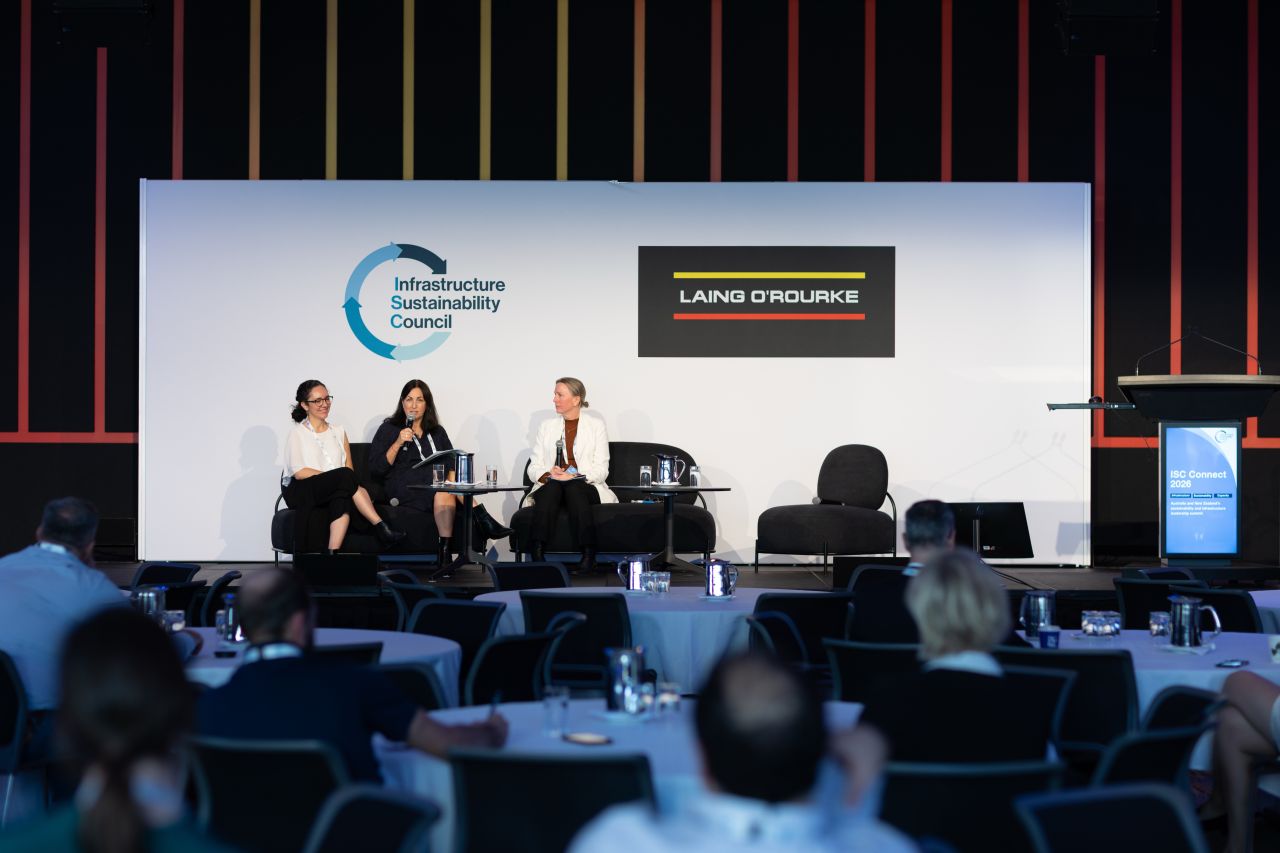
One of the strongest messages emerging from the Infrastructure Sustainability Council (ISC) Conference in Brisbane this week was that nature should no longer be viewed as a constraint to development - it should be recognised as infrastructure in its own right.
Circle COO Jo Jalfon shared the stage with Sally Wilson (Principal, GHD) and Andrea Vargas (Principal Sustainability Consultant, Arcadis), and challenged delegates to reconsider traditional approaches to infrastructure planning in light of the growing evidence for nature-based solutions.
Sally highlighted the tendency to treat ecosystems as environmental considerations rather than productive assets. “Yet a single ecosystem can simultaneously provide flood attenuation, water treatment, erosion control, cooling, habitat and recreational benefits - functions that would otherwise require multiple pieces of conventional infrastructure.”
As Sally noted, healthy ecosystems can adapt, self-repair and continue delivering services without major capital replacement. “When managed to clear levels of service, they can outperform traditional infrastructure on lifecycle costs, carbon outcomes and regulatory risk,” Sally explains.
“These conversations are becoming increasingly relevant as Australia implements major environmental reforms. The Environment Protection Reform Act 2025 introduces mandatory biodiversity net gain requirements and strengthens expectations that environmental impacts are first avoided, rather than simply offset.”
Andrea reinforced that nature is often considered separately from infrastructure design rather than as a core part of the solution. “The result can be fragmented approaches where carbon, climate, biodiversity and resilience objectives are addressed independently, creating unintended trade-offs.”
As Andrea shared, the challenge is not a lack of evidence. “Tree canopies can reduce urban temperatures by up to 12 degrees. Wetlands absorb wave energy, improve water quality and enhance biodiversity. Riparian corridors reduce flood peaks. Nature-based infrastructure is capable of delivering multiple outcomes through a single investment.”
The challenge, Andrea argued, is that nature is often introduced too late in project design and remains difficult to value using traditional infrastructure frameworks. As a result, when budgets tighten, it is frequently the first element removed.
She pointed to projects such as the UK's Lower Thames Crossing as examples of what becomes possible when nature is considered from the outset. In both cases, nature-based solutions were embedded as core infrastructure components rather than added as landscaping after major decisions had already been made.
As Jo shared, this approach is becoming increasingly important given the scale of the infrastructure challenge facing both New Zealand and Australia.
“New Zealand faces an infrastructure deficit exceeding $200 billion, while Australia's challenge is even larger. Meeting these needs will require us to consider every viable option available. That does not mean replacing traditional infrastructure. It means strengthening it.
“If we want resilient, productive and adaptable communities, we need to assess grey, green and blended solutions at the earliest stages of planning and investment. Because when infrastructure decisions will shape communities and economies for decades, the greatest risk is not choosing the wrong solution. It is failing to consider all viable solutions in the first place - including the one already working for us.”
Read more on The Aotearoa Circle’s Natural Infrastructure Plan here.

-48.jpeg)
-47.jpeg)