
This month, we spoke with Genesis Chief Executive Malcolm Johns, who challenges us to confront a simple reality: the barrier to New Zealand's energy transition is not ambition, but pace. Malcolm calls for faster electrification, greater investment certainty and a new appreciation of natural infrastructure, arguing that healthy rivers, wetlands and catchments are just as critical to our future prosperity as the power stations, transmission lines and renewable generation they support.
What makes the energy sector unique is its volatility. Electricity supply and demand are shaped by wind, rain and sunshine, and New Zealand’s system is unusually exposed to those natural rhythms. We’re fortunate to have significant renewable resources and hydro storage, but we still rely on fossil fuels across transport, machinery and many critical assets. The transition therefore is not simply about generating more renewable electricity; it is about reshaping the entire energy system.
At Genesis, we use a simple framework to describe the scale of change required. We call it 60/95/100, and it sits within our broader Gen35 strategy.
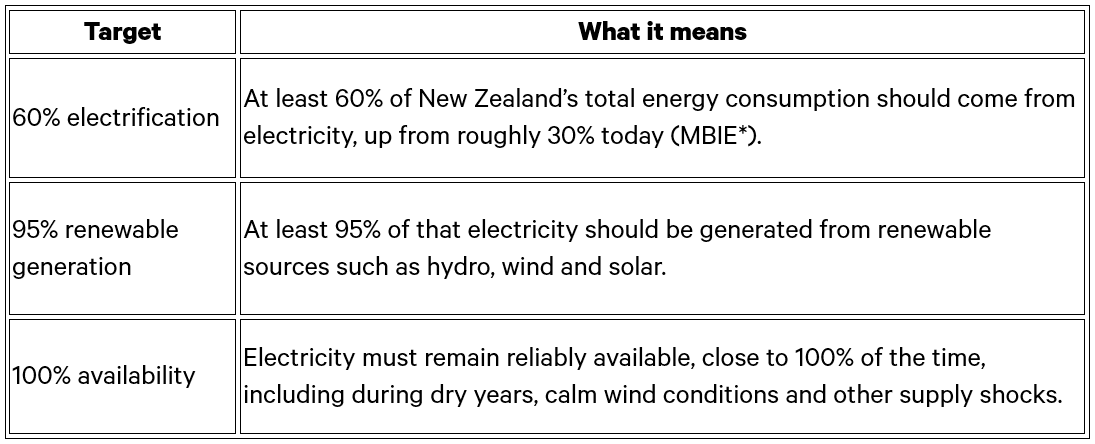
Those numbers capture New Zealand’s core challenge: decarbonise, keep the lights on, and do it affordably. But the problem is not ambition. It is pace. We are not electrifying quickly enough.
New Zealand has substantial renewable resources, capable developers and willing investors. What is needed is faster deployment, better coordination and diversified firming and energy storage capacity to support a highly renewable but volatile grid.
For that reason, we are planning in five-year steps through to 2040 rather than relying on distant aspirations. The first priority is straightforward: build more renewable generation capacity and the infrastructure that allows it to serve the country 365 days a year.
That is also why Huntly Power Station is evolving. Historically it operated as a base-load coal generator. Increasingly its role is to provide peaking, firming and security for the grid during periods when renewable output is constrained.
Despite a changing climate, I am optimistic about New Zealand’s ability to meet its energy-security and emissions goals, but optimism alone does not finance infrastructure. Investors need confidence that the rules of the game will be stable. We would never redesign the road code every few years and expect private capital to build highways at scale; energy investment requires the same policy durability.
Energy is prosperity – yet the long-term security of New Zealand’s electricity system depends on something even more fundamental: freshwater. This is where the conversation moves beyond conservation into infrastructure economics.
Healthy rivers, wetlands and coastal systems reduce operational risk and long-term cost. Restored catchments provide flood mitigation, natural cooling and sediment filtration. Strategic planting helps stabilise slopes and protect roads, rail lines and transmission corridors. These are not abstract environmental benefits; they directly protect generation assets, substations and the transport networks that support them.
In practical terms, nature’s ability to absorb floodwaters, stabilise soils and filter sediments lowers outage risk, maintenance costs and replacement costs across energy and transport infrastructure. Natural systems make hard infrastructure more resilient.
And if we want true resilience, we need to take an intergenerational approach to infrastructure investment and deploy financing models that recognise natural infrastructure as productive infrastructure.
Treated properly, natural infrastructure can be both an environmental asset and an economic differentiator that attracts international capital.
New Zealand’s competitive advantage is not only that we have renewable resources. It is that we have the opportunity to combine world-class natural assets with modern infrastructure and stable institutions. If we treat nature as productive infrastructure rather than a residual concern, we can improve resilience, lower long-term costs and accelerate the transition to a more prosperous, low-emissions economy.

-48.jpeg)
-47.jpeg)