Addressing New Zealand’s current $200 billion infrastructure deficit requires new thinking. The Aotearoa Circle’s Natural Infrastructure Plan points to examples of this including how nature-based solutions can address this gap in cost-effective and resilient ways.
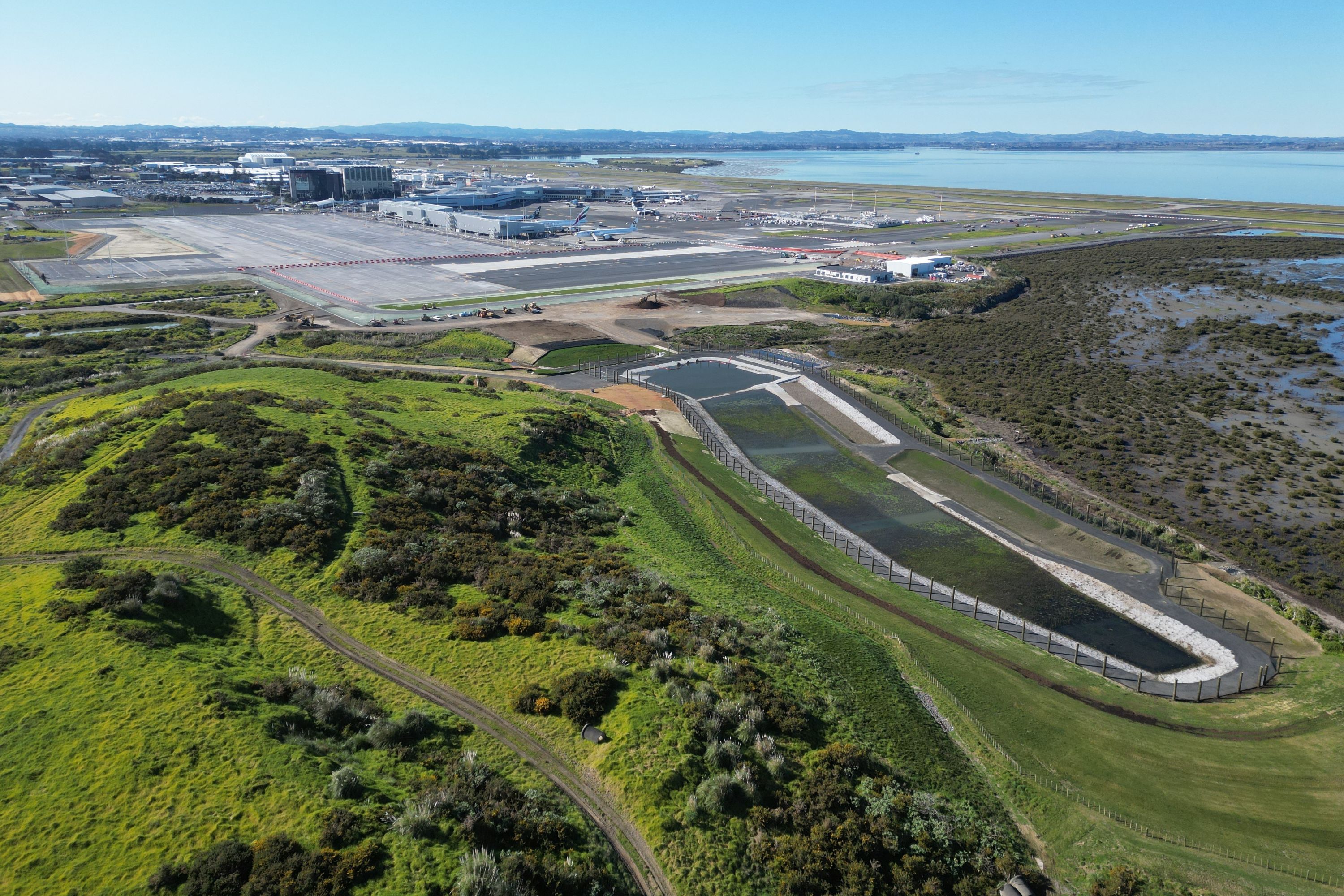
A live example, shared in the case study element of the Plan, is Auckland Airport.
The Master Plan to 2047 for our biggest airport recognises the importance of stormwater management, including the need for stormwater treatment to meet and where possible exceed environmental standards prior to discharge to the Manukau Harbour. This needs to be achieved while maximising valuable aeronautical land.
To enable expansion of taxiways and aircraft parking, the airport needs to convert more than 100 hectares of land into hard surfaces. That means significantly more stormwater to manage in an area highly valued for aeronautical purposes.
This required a different way of thinking explains Andrea Marshall, Auckland Airport’s Head of Environmental Planning & Sustainability.
“Three core challenges shaped the project. The first was land constraint. The most suitable location for further stormwater treatment was also highly valuable aeronautical land. The second was rising environmental expectations. While existing consents focus on removing total suspended solids, future requirements are likely to be more stringent. And the third was a need for future proofing. We needed a solution that could respond to climate change impacts, including extreme rainfall and sea-level rise, while scaling with the airport’s growth.”
For these reasons, a conventional stormwater pond, traditionally used to manage stormwater, wouldn’t work. Instead, the airport turned to a nature-based solution.
“We worked with Beca to develop New Zealand’s first Coupled Wetland Biofilter (CWB),” Marshall explains. “It combines engineered design with natural processes across three treatment stages.”
The system begins with a sediment forebay which slows water and captures coarse debris and sediment. The water then flows into a constructed wetland, where around 20,000 native plants filter finer contaminants. During high flows, water is directed through a raingarden biofilter, providing additional filtration through soil and vegetation.
This layered approach ensures stormwater continues to be treated even during heavy rainfall events - something traditional systems often struggle to achieve.
But Marshall says one of the project’s biggest advantages is efficiency.
“Compared to a traditional retention pond, the CWB requires just one-third of the land area to treat the same volume of stormwater to a higher standard. That means more space is available for aeronautical use, supporting the airport’s expansion and long-term economic growth.”
Completed in 2025, as part of the airport’s $465 million northern airfield expansion, the CWB is now operating as a key piece of long-term infrastructure.
“Monitoring to date shows it is performing in line with expectations” Marshall shares. “It’s also attracting interest from councils, engineers and developers across the country.”
The Aotearoa Circle’s Chief Executive Vicki Watson says the airport’s innovative approach shows what’s possible when infrastructure works with nature, not against it.
“By combining innovation, ecological design and long-term thinking, Auckland Airport has created a solution that supports growth, protects the environment, and builds resilience for the future, setting a new standard for infrastructure in Aotearoa.”
More information:
Read more on Auckland Airport’s CWB application, and other examples of nature-based solutions being deployed as natural infrastructure, here
Watch our recent webinar featuring Andrea Marshall and others on how New Zealand can shift from risk to resilience by recognising and deploying, natural infrastructure solutions here.

-48.jpeg)
-47.jpeg)